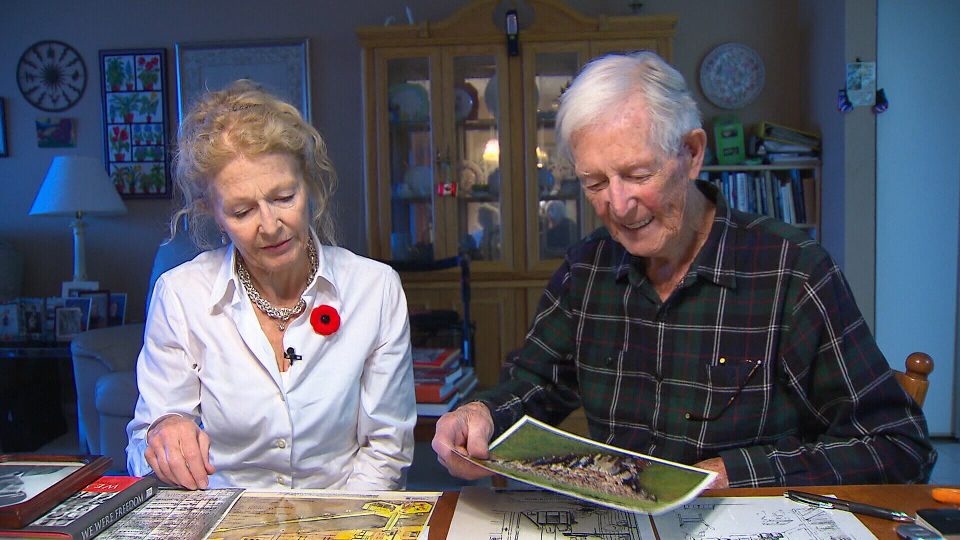

World War II veterans are individuals who made invaluable contributions to the future of their nations. Although Toronto itself was not directly impacted by active combat, many residents served abroad, supporting the Allies and protecting Canada from Nazi aggression. Albert Wallace was one such individual who fought for the freedom of Europeans during the Second World War. Learn more about his remarkable story and the challenges he faced, as told on torontoyes.com.
A Miraculous Survival

Albert Wallace was born in Toronto. As a young man, he found himself on the frontlines. In an interview with CTV News, Albert recalled a near-death experience when his plane was shot down behind enemy lines, leading to his capture and internment in a prisoner-of-war (POW) camp.
The harrowing event occurred on May 12, 1943, when Albert was part of a crew involved in the third wave of bombing over a German city. His aircraft came under heavy enemy fire at an altitude of 20,000 feet, bursting into flames and forcing the crew to bail out. Albert vividly remembers sitting in the darkness, hesitating to jump, before finally summoning the courage to leap. Upon landing, he was approached by two farmers.
The farmers helped Albert to his feet and invited him into their home. He stayed there for several days before German military officers arrived. Dressed in long coats and armed with rifles, the officers transported Albert on a motorcycle sidecar to the nearest police station.
Later that same day, Albert and other surviving members of his crew were released from the station and transferred to a POW camp.
Life in Captivity

Throughout the war, Albert was held in two separate camps. The first was an interrogation camp, where German officers posed as members of the Red Cross, questioning Albert about his address in Canada and the names of his family members. Once, he was interrogated by an officer who demanded information about a secret weapon. Albert, not understanding what the officer was referring to, remained silent.
Following this, Albert was sent to Stalag Luft III, a POW camp infamous for its daring escape attempts. He was placed in Barrack 104, which concealed a secret tunnel used by prisoners in escape efforts.
The tunnel extended beyond the barbed wire fence encircling the camp, which prevented prisoners from fleeing. In March 1944, 76 prisoners managed to escape through the tunnel, though few survived their freedom attempt.
When Albert first arrived at Barrack 104, the tunnel’s existence was hidden from him. Once he learned about it, he chose not to attempt an escape. Albert spent a total of 18 months in captivity.
In January 1945, news of the Soviet army’s advance into Germany reached the camp. Albert and other prisoners were ordered to evacuate to a farm.
In May 1945, an armored vehicle arrived at the farm. A man climbed out and revealed himself to be a British officer, delivering the news that the war was over.
Albert was transported to London, then to Halifax, and finally back to Toronto, where his mother awaited his return.
After being discharged from the Royal Canadian Air Force, Albert resumed work at Loblaw’s, a local restaurant.
In 2018, Albert celebrated his 98th birthday. He continues to share his life stories with younger generations, emphasizing the importance of living an honorable life. On Remembrance Day, Albert urges young people to reflect on how to live meaningfully.
Albert’s daughter compiled his experiences into a book based on letters her grandmother had preserved, ensuring his remarkable story endures for future generations.