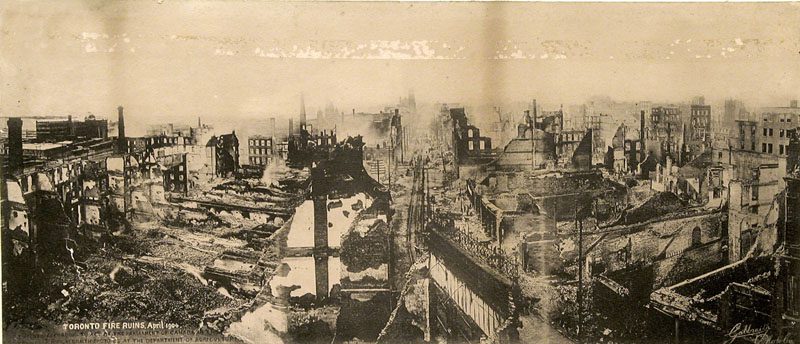

Toronto has a fascinating history. Many events have shaped our city’s development. In the early 20th century, our city experienced a horrific event – a massive fire. Today, we’ll delve into this unfortunate chapter of its past. Read more about this on torontoyes.com.
What We Know About the Fire

This devastating event occurred on April 19, 1904, in Toronto. It was one of the largest fires in the city’s history, destroying a significant portion of its downtown core.
The fire started around 7 p.m. in a clothing factory building on Wellington Street West, near Bay Street. To this day, the exact cause of the fire remains unknown. However, it is speculated that it could have been a faulty furnace or electrical problems.
The fire spread very quickly through the densely populated industrial and commercial district. Firefighters arrived to battle the blaze. However, it wasn’t that simple. Strong winds, temperatures around -4 degrees Celsius, and snow complicated the firefighting efforts. That’s why the fire raged for about nine hours before firefighters could extinguish the flames.
It’s worth noting that crews from neighbouring cities, including Hamilton and Buffalo, came to assist the local firefighters.
The Aftermath of the Fire
This fire will forever remain in Toronto’s memory. The blaze resulted in the destruction of 104 buildings. Remarkably, all city residents survived; no lives were lost in this fire.
It should be noted that about five thousand people lost their jobs, and the damages were estimated at over 10 million Canadian dollars. This was an enormous sum for the early 20th century. Additionally, the fire occurred in Toronto’s industrial district, and mostly industrial properties were affected.
Lessons Learned
Such a large-scale fire served as a wake-up call for Toronto’s authorities. The event became a crucial catalyst for changes in the city’s urban planning. Consequently, new approaches to development were implemented. Stricter fire safety requirements were also adopted, ensuring a more effective organization of urban space.
In general, after the fire, regulations for the use of fire-resistant building materials were strengthened, reducing the risk of rapid fire spread. Furthermore, urban planning began to incorporate wider streets and firebreaks between buildings, which facilitated access for fire trucks and firefighting efforts.
Special attention was given to city zoning, particularly the separation of industrial zones from residential areas, to minimize risks to the population.
Moreover, the fire spurred the development of public spaces and open areas, which served as natural fire barriers while also enhancing the quality of the urban environment.
The fire compelled Toronto’s city government to adopt several measures to strengthen the fire service:
- Expanding the roster of firefighters and increasing the number of fire units for a more rapid response to emergencies.
- Upgrading firefighting equipment, purchasing new fire trucks and gear, which increased firefighting effectiveness.
- Implementing better organization within the fire service, including improved communication and alarm systems.
- Enhancing the training and preparation of firefighters to raise their professional standards.
- Developing and implementing new fire safety standards in building construction and operation.
As you can see, the 1904 Toronto fire became a catalyst for creating a more professional, better-equipped, and more organized fire service capable of meeting the needs of a metropolis.
We hope this material was informative, and you’ve learned more about your home city and drawn your own conclusions.